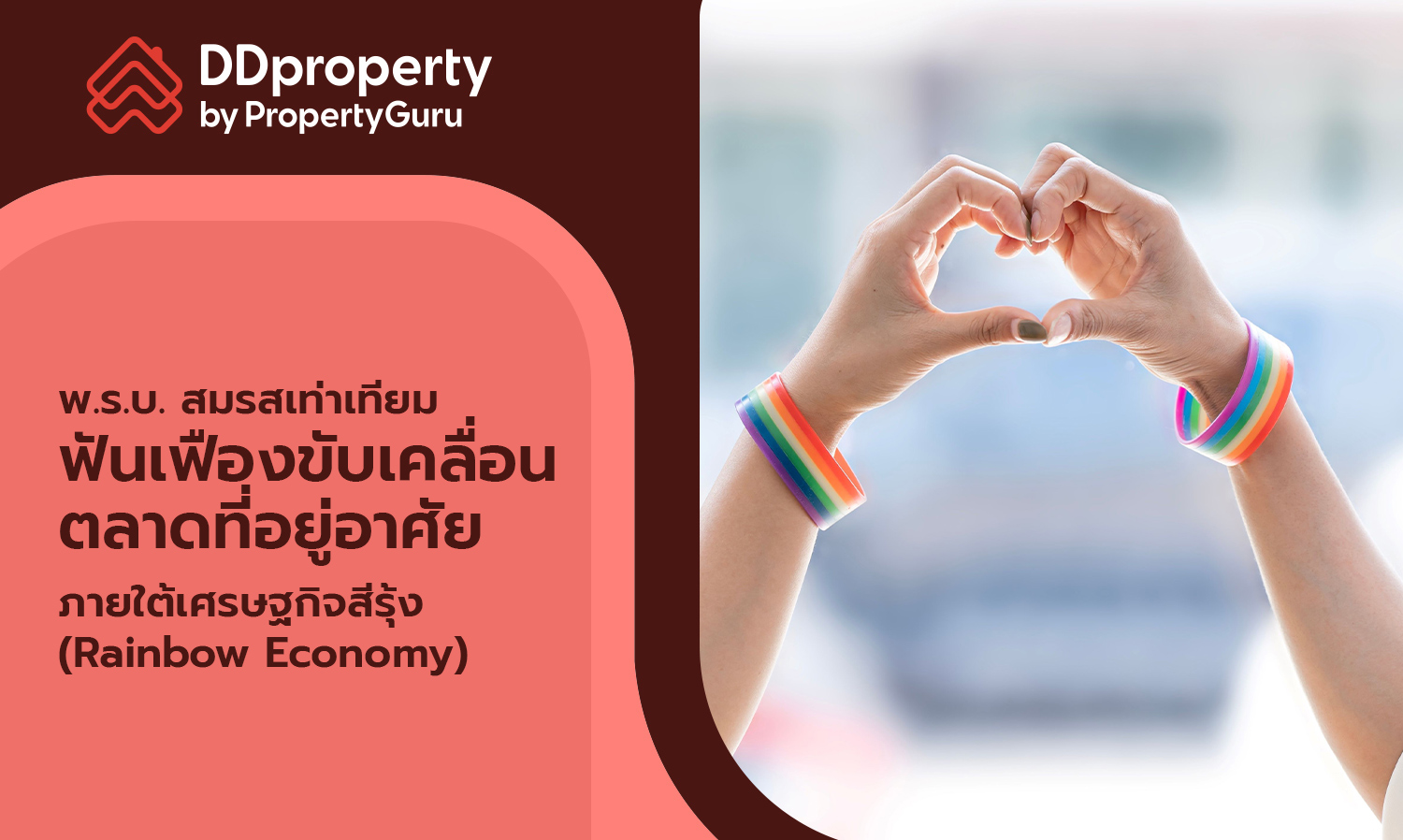
The Equal Marriage Act: A Catalyst for the Housing Market Under the Rainbow Economy
The year 2024 is significant for the LGBTQIAN+ community in Thailand, following the approval of the draft of the Equal Marriage Act by the House of Representatives on March 27. This marks a positive step towards gender equality in Thailand, providing legal recognition and rights for LGBTQIAN+ couples, thereby reducing the gaps that create gender inequality. Once officially enacted, Thailand will become the first country in Southeast Asia to legally allow LGBTQIAN+ couples to marry.

The passage of the Equal Marriage Act represents a significant positive change and an opportunity for both the government and businesses to attract the purchasing power of this consumer group, driving the Thai economy. According to data from LGBT Capital, the global spending power of the LGBTQIAN+ consumer base (LGBT-GDP) in 2023 is estimated at approximately $4.7 trillion annually, with around 3.7 million Thai LGBTQIAN+ individuals contributing about $26 billion to this figure. This reflects the spending potential of this consumer group and presents an opportunity for the real estate sector to cater to and grow alongside the Rainbow Economy.
The Equal Marriage Act: A Step Towards Basic Rights for All Couples In addition to allowing LGBTQIAN+ individuals to marry legally, the Equal Marriage Act encompasses a range of rights, including:
- The right to engage in engagement, marriage, and divorce. LGBTQIAN+ couples will have legal rights to engage or marry, allowing them to register their marriage in Thailand and enjoy the same rights as heterosexual couples. In cases of divorce, whether voluntary or contested, they will also receive equal protection.
- The right to jointly adopt children, enabling LGBTQIAN+ couples to adopt their partner's child as their own, unlike before when only one partner could adopt due to the lack of legal recognition.
- The right to care for their spouse's life legally, including the right to consent to medical treatment and make healthcare decisions on behalf of their spouse. Additionally, LGBTQIAN+ couples will have access to state benefits and welfare as spouses, including health insurance and social security rights.
- The right to inherit from their spouse. If the inheritor is a legally registered LGBTQIAN+ spouse, they will be exempt from inheritance tax. If one partner dies without a will, the surviving partner will be considered a legal heir entitled to inherit.
- The right to manage joint property or marital assets. LGBTQIAN+ couples will have legal rights to manage jointly acquired assets during marriage, including salaries, bonuses, or assets acquired through inheritance or gifts designated as marital property.

The Equal Marriage Act serves as a ladder leading LGBTQIAN+ couples to basic rights across various aspects, including the opportunity to jointly apply for loans to purchase property as spouses. Data from the Housing Purchase Confidence Index report for Bangkok and surrounding areas in Q1 2024 indicates that 4.9% of consumers looking to purchase housing are LGBTQIAN+, reflecting a genderless trend in housing demand. Therefore, they should receive equal access to housing loans.
Unlocking Equal Housing Opportunities for LGBTQIAN+ Couples with the Equal Marriage Act
DDproperty, Thailand's leading real estate platform, reveals that while Thai society is becoming more accepting of sexual diversity, there is still no official recognition of marital relationships, which affects the ability of LGBTQIAN+ couples to jointly apply for housing loans. Typically, if applying alone, LGBTQIAN+ individuals can apply for housing loans but face restrictions when trying to apply as joint borrowers, as banks require joint borrowers to be closely related individuals, such as family members or a heterosexual couple, regardless of their marital status. Currently, Thai law does not recognize the registration of LGBTQIAN+ marriages, rendering such relationships legally ineffective.
However, several banks are beginning to offer special campaigns to allow LGBTQIAN+ couples to jointly apply for home loans without gender restrictions. Generally, these campaigns have similar basic requirements, such as:
- Thai nationality, aged 20 and above.
- Stable income, with a minimum income of 15,000 baht for both the primary and joint borrowers (some banks require the primary borrower to have an income of at least 50,000 baht).
- Permanent employees must have a total work experience of at least 2 years (some banks have no such requirement).
- Borrowers must provide documentation or evidence of their relationship or cohabitation for at least 1 year, or as specified by the bank, such as a joint household registration, joint bank account, wedding photos, or other evidence confirming their relationship (some banks have no such requirement).
Additionally, borrowers must meet general housing loan criteria, including a debt-to-income ratio not exceeding 30-40%, having savings of at least 10% of the property price, and providing a 6-month bank statement. The loan amount may cover 100% of the requested amount or vary according to each bank's conditions. However, banks and financial institutions are becoming stricter in their loan assessments to reduce the risk of bad debts. Therefore, consumers should prepare financially by saving diligently and reducing unnecessary debts to create good financial liquidity and demonstrate their ability to repay loans, which will facilitate the home loan application process and ensure sufficient funding for purchasing suitable housing.
Options for LGBTQIAN+ Couples to Jointly Apply for Loans Even Without Marriage
Due to the restrictions on joint loan applications for LGBTQIAN+ couples, alternative financing options are emerging for purchasing housing. Some banks offer business loans or SME loans that LGBTQIAN+ couples can use to purchase permanent assets for business operations, such as establishments with land or vacant land for business use.
However, using SME loans is only a temporary solution for homeownership, as it comes with challenges to consider, such as a maximum loan term of only 10 years, compared to housing loans that offer repayment terms of up to 30-40 years, and higher interest rates than standard housing loans. Therefore, LGBTQIAN+ couples should carefully consider and study the details of various loan campaigns before deciding to purchase housing, focusing on the suitability for actual living and financial readiness.
It is important for all couples planning to apply for joint loans to remember that the ownership of the house will belong to both parties. If in the future one party wishes to transfer or sell to another, consent from all joint borrowers will be required, even if the primary borrower is the only one making the payments. Additionally, if issues arise regarding ownership, the borrower may need to pursue legal action and provide evidence of payments to support their claim that the primary borrower is indeed the sole payer, which may take considerable time.
Currently, the draft Equal Marriage Act is still under consideration by the Senate before being enacted into law in the future. This represents another significant social change in Thailand. However, many banks and financial institutions are now allowing LGBTQIAN+ couples to jointly apply for loans through special campaigns, with varying assessment criteria. The leading real estate platform in Thailand, DDproperty, has compiled information on banks offering loans for joint borrowers with diverse sexual orientations, along with news and useful information in the real estate sector, to assist LGBTQIAN+ individuals in making informed decisions before choosing housing, while also serving as a platform for buying, selling, and renting properties across various locations in the country, helping consumers of all ages prepare confidently for homeownership.